This blog is about Glasgow’s real and mythological relationship with the tank in the years immediately after its first use in battle. It deals briefly with how a vision has been cemented in the wider consciousness of tanks roaming the streets of Glasgow ‘oppressing’ the population. It isn’t one of my ‘Mythologies’ series, but there are ‘mythological’ elements!
One of the recurring tropes of the Battle of George Square – the riot during the Forty Hours Strike in Glasgow in 1919 – is that of there were ‘tanks on the streets’ or even ‘tanks in George Square’. I have written elsewhere about how the army was called in by the Sheriff of Lanarkshire in the middle of the riot, as ‘military aid to the civil power’, troops beginning to arrive from 10pm on the night of the riot. And how the army, in the absence of reliable intelligence about what they might face, and perhaps fearing a re-run of the Easter Rising in Dublin in 1916, included six tanks as part of the force; these arrived four days later, on 3 February, and never left the Cattle Market.[1] Iain Maclean has written ‘the net effect of the tanks in the Cattle Market was probably the same as that of the police misbehaviour in George Square: it gave the strike a romantic history which successfully concealed an otherwise ignominious failure’.[2] It is indeed difficult to exaggerate the legacy of the tanks in the public consciousness, as the persistence of the ‘there were tanks in the Square’ version of history demonstrates.
Patrick Wright, in his book about the impact of the tank in modern culture, described the tanks in Glasgow as:
…an intimidating war machine ferrying policemen about and applying its “moral effect” on the streets of a British city… the thought of those English tanks would linger in that predominantly left-wing city’s political memory for the rest of the century – at once proof of the reality of class war, and also shocking emblems of a British state that was prepared to crush its own people.[3]
Occasionally one gets the impression, as here, that the ‘Battle’ is like a lump of narrative clay picked up out of its box and moulded to fit whatever pre-determined shape has been left for 31 January 1919 in that author’s version of Red Clydeside, without very close examination of the complexity of events or their causation. And so, the military deployment and the tanks become what they need to be to fulfil the writer’s need, and to add impact and drama. (The idea that the tanks were used for ‘ferrying policemen about’ appears to be an elaboration by Liddell Hart in his history of the Tank Corps, for which there is no evidence,[4] unreferenced by Wright.)
[1] Gordon J Barclay, “‘Duties in Aid of the Civil Power’: the deployment of the army to Glasgow, 31 January to 17 February 1919,” Journal of Scottish Historical Studies 38.2 (2018). Gordon J Barclay, “‘Churchill rolled the tanks into the crowd’: mythology and reality in the military deployment to Glasgow in 1919,” Scottish Affairs 28.1 (2019).
[2] Iain McLean, The Legend of Red Clydeside (Edinburgh: John Donald 1999), 138.
[3] Patrick Wright, Tank : the progress of a monstrous war machine (London: Faber, 2000), 127, 130.
[4] Basil Henry Liddell Hart, The Tanks. The history of the Royal Tank Regiment and its predecessors – Heavy Branch Machine-Gun Corps, Tank Corps and Royal Tank Corps, 1914-1945, 2 vols. (London,, 1959), vol 1, 205.

A photograph taken in early February 1919 of the tanks in the Cattle Market. In the foreground are three Medium C tanks; behind, three larger Mark V*.
This has been done, for example, in documentary films where moving and still images of ‘tanks on the streets’ have been introduced to dramatize what was in reality a not very visually dramatic event. The tanks in Glasgow appeared ‘on the streets’ of the city only for the time it took them to drive from College Goods Station to their temporary depot at the Cattle Market, about 1km away; not surprisingly, therefore, no images exist of them anywhere but in the Cattle Market. The creators of documentary films have decided that, in the absence of anything to provide visual drama to their narrative, they would introduce images and film of other places and/or other times, and usually from very different circumstances (most often, footage from fund-raising parades), without mentioning their sleight of hand.
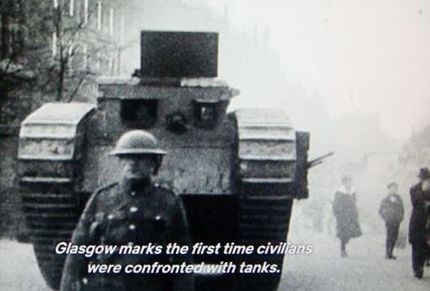
Episode 1 of the Netflix documentary ‘The Age of Tanks’ (2017)[5] includes, towards its end, a series of contemporary stills and cine film illustrating, it is implied, the tanks in Glasgow after the riot: only one image, a still of the tanks in the Cattle Market, is actually of tanks in Glasgow in the aftermath of the ‘Battle’. Other photographs and film are shown accompanied by a highly dramatized narrative. Shown immediately after film of revolutionary crowds in Russia, the statement that ‘the people of Glasgow take to the streets’ and that ‘this new Communist uprising is to be dealt with accordingly’ seem designed to inject high drama. Film of two fund-raising parades (one in Glasgow, the other an uncertain locality) sandwich between them film of the tanks deployed to Liverpool in August 1919, during the police strike, accompanied by the portentous statement: ‘And so, the weapons meant to win the war, become the tools of oppression. Glasgow marks the first time civilians were confronted with tanks’. No-one was ‘confronted’ with tanks in the streets of Glasgow: Liverpool was the first time tanks actually ‘confronted’ a civilian population, in the sense that they were actually ‘on the streets’; their deployment to control non-political criminal looters doesn’t, however, fit a narrative of political conflict and oppression very well.
[5] Available via Netflix. Someone has helpfully pirated the relevant section on Glasgow on their YouTube channel: https://www.youtube.com/watch?v=fcz-jvyMsvw
A fund-raising parade, date and location unknown, used in the Netflix ‘Age of Tanks’ documentary, to press home the narration ‘Glasgow marks the first time civilians were confronted with tanks’. The scene is not of ‘confrontation’.

A still taken from film shown in the ‘Age of Tanks’ documentary, accompanied by the narration, ‘Glasgow marks the first time civilians were confronted with tanks.’ The film is in fact of Liverpool in August 1919, which is where civilians were in fact ‘confronted with tanks’ for the first time. The film is available on the British Pathé historical collection website: https://www.britishpathe.com/video/tanks-stand-by
Glasgow had had two previous visits by tanks, a year before the ‘Battle’, in January 1918, and again only days before the riot, between 13 and 18 January 1919. The 1918 visit has been cemented in popular memory by a single photograph which has, however, been misdescribed as showing one of the ‘Battle’ tanks, on its way for oppressive purposes to George Square a year later. ‘Tank Week’ in Glasgow between 14 and 19 January 1918 was an extraordinary event which dominated the life of the city. Veteran tank ‘Julian’ (No. 113) toured cities and towns across Britain to promote the sale of War Bonds and had arrived in Glasgow from his triumph[6] in Edinburgh on the 13th (having raised £4.4M). The (in)famous ‘Julian’ photograph was first published on the front page of The Bulletin on 15 January 1918, but many images of ‘Julian’s’ progress were published. ‘Julian’ paraded round the city and even went through his paces climbing specially built obstacles and ended up parked in George Square for the selling of the War Bonds.
[6] Whereas ships are ‘she’, tanks are generally ‘he’. I don’t know why.
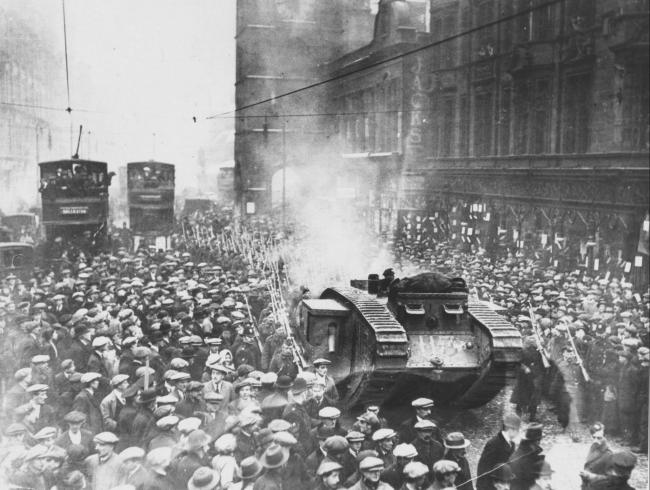
Veteran tank No. 113, ‘Julian’, during ‘Tank Week’ on 14 January 1918, published in the next day’s Bulletin newspaper. This image is that most often misrepresented as being of tanks in use a year later at the ‘Battle of George Square’.
There was intense competition between cities about how much money they could raise. Glasgow raised the greatest sum by some considerable way – £14.17M, compared to the next highest, Birmingham – £6.7M[7]
The second fund-raising event, between 13 and 18 January 1919, to sell ‘Peace Bonds’ involved three tanks, two heavy tanks (I suspect Mark V*, as one report describes their capacity to carry troops) ‘Haig’ and ‘Beatty’ and a light ‘Whippet’, ‘Julian’s Baby’. The tanks again went through their paces, climbing obstacles on Glasgow Green and parading round the streets every day. ‘Julian’s Baby’, however, proved mechanically unreliable and dropped out of a number of events. It was, however, when working, sent through the streets to collect any donation larger than £25,000.[8] Once again, the tanks parked in front of the City Chambers, in George Square, where the bonds were on sale. In the end, the take was less than in 1918, but a nevertheless respectable £11,361,976.[9] ‘Beatty’ left the city mid-week to go to aid the fund-raising effort in Leith.[10] Hopes that ‘Julian’ might come to fill his place do not seem to have been fulfilled, despite a reported promise by Churchill.
A feature of the 1919 event was that people could have rides in the larger tanks, including the Lord Provost’s daughters.[11]

An image used in the ‘Age of Tanks’ documentary, with the narration, ‘The people of Glasgow yield to the tanks that they themselves have paid for.’ It appears to be from one of the fund-raising parades during the Victory Bond week in January 1919. ‘Julian’s Baby’ leads the procession.
It is occasionally claimed on social media that a relative, usually a grandparent, saw or in one extreme case ‘rode on’ a tank in George Square on 31 January, during the riot. Inevitably, it is impossible to convince their descendants that, as there were no tanks in the city until 3 February, such an encounter was impossible. As I worked through the evidence and thought about the images misrepresented in the ‘Age of Tanks’ documentary, I began to wonder if memories and stories about more than one event had been confused.
Could it be that memories of tanks rumbling round the streets during the fund-raising parades in January 1919, have been confused with memories or stories of the ‘Battle’, only a few days later. Oral history notoriously represents people’s ‘lapses of memory, the lies, the misinterpretations and the Freudian slips’, and ‘not just what people did, but what they wanted to do, what they believed they were doing, and what they thought they did’.[12]
[12] Seán Damer, Towards a people’s history of Glasgow, Discussion paper, (Glasgow: Glasgow University, 1980), 19.; A. Portelli, The Death of Luigi Trastulli and Other Stories: Form and Meaning in Oral History (Albany, NY: State University of New York, 1991), 50.

A week before the ‘Battle’ The Bulletin (Saturday 25 January 1919) humorously suggests that tanks could take over from the trams…
A parallel ‘memory’ of the Square on 31 January 1919 is of the ‘howitzer’. As far as I can determine, the first mention of this weapon being deployed is in Harry McShane’s 1978 memoir ‘No Mean Fighter.[13] Subsequently, multiple ‘howitzers’ have been claimed, and their location has varied from flanking the entrance to the City Chambers, to a position on the roof, although the British 4.5-inch howitzer weighed 1.3 tonnes! No contemporary source mentions a howitzer and it may be that it is another confused memory: Alec MacNeill, a Twitter contact, has suggested the confusion arises from the presence in the Square of a German ‘trophy’ howitzer, presented to the city in the previous December, and placed in the Square. Hundreds of such weapons were presented to cities, towns and even villages around this time.[14]
Six tanks were taken to Glasgow after the ‘Battle’, three Medium Cs (armed with machine guns) and three Mark V* (Mark V Star) (armed with a pair of 6pdr guns in side sponsons, and machine guns). The key principle in ‘military aid to the civil power’ is that any force used must be proportionate. The massacre at Amritsar a few weeks later demonstrated what happened when the principle of proportionate force was ignored. Were the tanks there merely to overawe? They could surely only have been used legally as ‘proportionate force’ in the face of armed insurrection like that in Dublin.
Although the last infantrymen left Glasgow in mid-February, we do not yet know exactly when the tanks left. By 18 March sections of tanks had been established in Edinburgh and in other major cities (not including Glasgow) in case of civil disturbance and it is possible that these were the relocated Glasgow tanks.[15] Four tanks of the right types were in the Victory Parade in Edinburgh in July 1919, ‘Topole’ in the lead, followed by ‘Old Bill’, ‘P-P-P-Percy’ and ‘K-K-K-Katy’ following. No names are visible on photographs of the tanks in Glasgow’s Cattle Market in January, but these may be the same tanks. However, at least two tanks took part in Glasgow’s belated Victory parade on 4 August, but so far, I have found nothing more about these.[16]
[13] Harry McShane and Joan Smith, Harry McShane no mean fighter (London: Pluto Press, 1978), 107.
[14] A howitzer is designed for long-range indirect fire, firing a shell over intervening obstacles, not very suitable for direct firing in an urban context.
[15] WO32/18920, Use of military personnel in aid of civil powers in event of civil disturbances and strikes: Great Britain, 1919, The National Archives, Kew.
[16] Glasgow Herald 5 August 1919
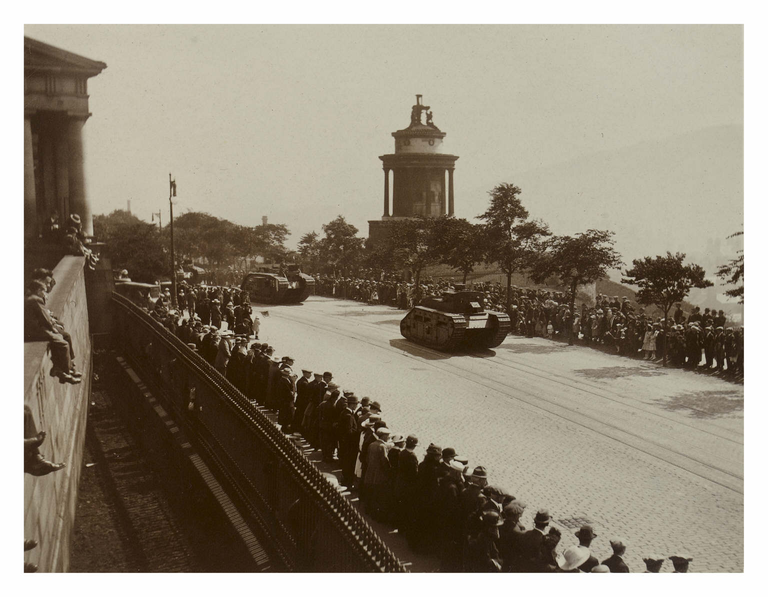
The Victory Parade in Edinburgh, 19 July 1919, passing along Regent Road. A Medium C is in the foreground, followed by two heavier tanks, possible Mark V*. (Collection, City of Edinburgh Item 9186)
There is more to be told about Glasgow’s relationship with the tank, for example those that were built there, the ‘tank fever’ that raised so much money and the oral history that perpetuates the myth of ‘tanks on the streets. Louise Heren and I are writing a book about events in Glasgow in 1919, and we would be very interested in hearing from anyone with more information on the tanks from all perspectives.
