
This is the second in a series of blog posts exploring invented or distorted versions of Scottish history, often used nowadays to promote particular political positions. Like the first blog, this is a summary of more detailed published articles. I’m posting it a few weeks before the 102nd anniversary of the Battle of George Square on 31 January 2021 in a probably vain attempt to prevent more nonsense being published at the end of the month!
The Myth
The core of the myth is the accusation that the government, most often Churchill personally, sent the army, often described as all being ‘English troops’, and supposedly ‘raw recruits’, accompanied by tanks, into George Square to suppress a strike, or even to stop a revolution. In some versions of the myth ‘hundreds died’.
The ‘Battle of George Square’ is perhaps the most mythologised event in twentieth-century Scottish history. The myths of ‘military invasion’ have been used to promote a narrative first of ‘establishment’ oppression and more recently of ‘English invasion’, orchestrated by the ‘villain-for-all-seasons’ Winston Churchill. Parts of the mythology continue to displace the reality in popular and even academic history, and recent Scottish school textbooks are almost completely mythological: ‘tanks in George Square’; ‘all English troops’ etc.
The Reality
In January 1919 a major strike was called in the Glasgow area to obtain a reduction in the working week to 40 hours. It was one of a number of strikes about working hours across the UK. The Municipal Employees’ Association did not join the strike, and the continued running of the tram system became a bone of contention: John Maclean described the ‘treachery’ of the city’s employees and the strikers’ processions seem to have deliberately blocked the tram traffic.
The strike leaders had made a request on 29 January through the Lord Provost that the government intervene to settle the strike, although a similar request to the Minister of Labour had been turned down a few days before. A large crowd gathered two days later, on Friday 31 January, to receive the answer, although the government’s refusal to become involved had been published in that morning’s newspaper. A riot broke out, apparently around the blocking of the trams in the SE corner of the square; civilians were injured in the subsequent baton charges. One hundred and forty policemen were on duty in the square (probably around a third of the normal available daytime shift for the whole city). Fearing that the trouble might be beyond the police force (whose total manpower was a fraction under 1300 men – almost 700 policemen still being in the army), the Sheriff of Lanarkshire called for ‘military aid to the civil power’ and troops started arriving at 10pm that night, after the trouble had largely died down.
The Sheriff of Lanarkshire had previously asked the government if troops would be available to him if needed. The War Cabinet had been reminded on 30 January that the government could not send in troops unless the government first declared martial law – only the Sheriff could call for ‘military aid to the civil power’. The strike went on for twelve days after the army arrived and the army did not interfere with it. A mainly Scots force, made up mostly of veterans, was deployed but did no more than guard ‘Vulnerable Points’ – gas works, railway stations and the like. The army decided what forces it would deploy when requested for such aid; in the absence of reliable intelligence, and perhaps fearing the worst – perhaps a re-run of Dublin in 1916 – the army decided to support the force with six tanks; they were parked in the Cattle Market, which they never left.
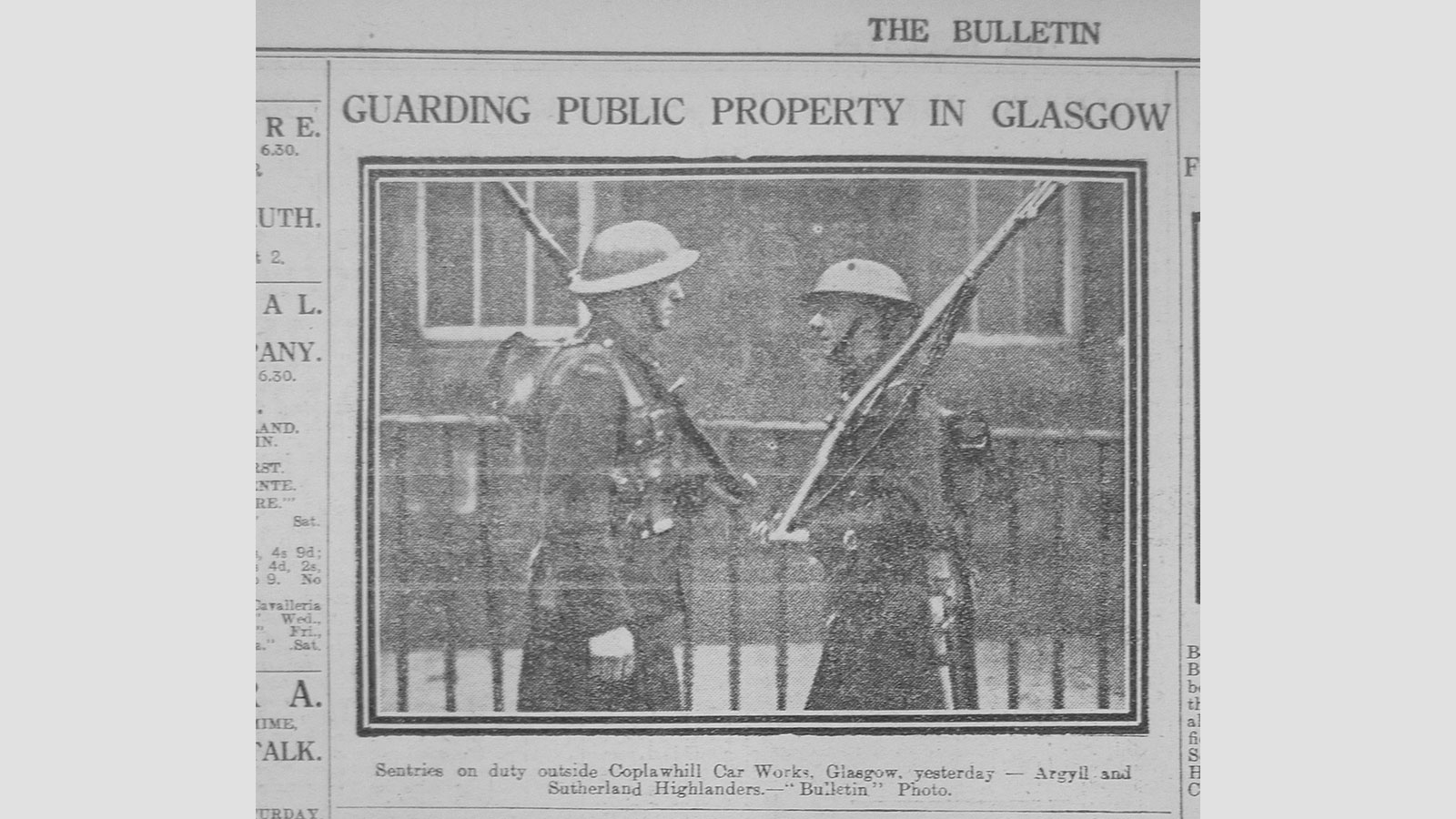
Soldiers of the Argyll & Sutherland Highlanders guarding a 'Vulnerable Point' in the aftermath of the riot.
Variants & Elaborations
Over the last century the events around ‘the Battle of George Square’ have accumulated a rich and complex mythology. Here is a list of the main variants, contrasted with the reality:
| Myth | Reality |
| The government sent the army | As already noted, the army was called in as ‘military aid to the civil power’, under the terms of the King’s Regulations (1912), by the only person who in 1919 had the power to do this, the Sheriff. |
| The army was sent by an ‘English/Tory government’ | The War Cabinet that discussed the situation in Glasgow, on 30 and 31 January 1919, was respectively two-thirds Scots and all Scots; on both days the majority of civilians in the room were Scots. The government was a coalition. |
| Churchill was responsible for the military deployment | This is an invention by Manny Shinwell in 1973 in one of his memoirs. He blamed Lloyd George in two later books, but provided no evidence for either accusation. Churchill, although War Minister, was not a member of the War Cabinet. |
| The government feared a ‘Bolshevist rising’ | Some members of government were very concerned by the possibilities of political unrest; others, including Churchill, had a more proportionate response. Discussions at the War Cabinet before the riot were not concerned with potential revolution, but with public order and the maintenance of the city’s street lighting. The Scottish Secretary’s infamous ‘this is a Bolshevist rising’ remark, made on 31 January while the riot was ongoing, was the only panicky statement made in the War Cabinet that week. |
| The army was sent to crush the strike. | The strike continued for 12 days after the army arrived; it did not interfere nor strike-break. |
| There were 60,000 / 90,000 / 100,000+ people in George Square. | Most contemporary sources suggest the crowd was 20-25,000 strong. A crowd of 60,000+ could not have fitted into the square and moved and reacted as has been described. Academic history is peculiarly erratic in claiming unrealistically large numbers. |
| All the troops were English. | Men from five Scottish regiments were deployed: KOSB, Royal Scots, Argyll & Sutherland, Gordon and Seaforth Highlanders, as well as men from the East Surrey Regiment (based in Bridge of Allan), and the Durham Light Infantry. |
| Scottish troops (often assumed to be the ‘local’ regiment, the HLI), were ‘locked in’ Maryhill Barracks. | The nearest HLI battalion was in Haddington, East of Edinburgh. The battalion then based in Maryhill (not the HLI) was not deployed, but also it wasn’t ‘locked in’. Army policy was always to use troops from a ‘distant locality’ for such deployments. |
| The troops were young, inexperienced recruits | Contemporary reports describe men with medals and wound stripes, lately returned from France. Photographs show mature middle-aged soldiers. |
| There were tanks/troops in George Square during the riot. | Troops started to arrive from 10pm in the evening after the riot; the tanks arrived three days later. There was no violent encounter between troops and civilians. The tanks never left the Cattle Market. |
| The army placed a ‘howitzer’ by the entrance to the City Chambers, or even on its roof! | The only howitzer recorded is a German ‘trophy’ weapon placed in the square in December 1918. I have tried and failed to imagine the 1.3 tonne howitzer being manhandled up the marble staircases to the roof… |
|
The army opened fire / people died |
The fighting between demonstrators and Glasgow police resulted in injuries on both sides, but only one fatality – a police constable who died from septicaemia in his wounds, months later. There was no violent interaction between the military and civilians. |
| The Red Flag was flown on the 31st. It is celebrated as reflecting the political sympathies of the crowd. | A Red Flag was flown from the municipal flagpole on Monday 27th. An attempt to repeat this on the 29th was foiled by a policeman. No flag was flown on the 31st. The strike committee was furious that political opportunists had tried to hijack a non-political strike. |

The red flag flying from the municipal flagpole in George Square on Monday 27 January 1919
A dozen or so accounts of events written by the strike leaders and their followers between 1919 and the 1980s continue to frame the narrative to a surprising degree, in the absence of a detailed evidence-based account of what happened in Glasgow in late January and February 1919. The events and the motivations of the main protagonists are far more complex and interesting than the over-simplified, highly dramatised and wildly inaccurate versions of the ‘Battle’ regularly shoe-horned into accounts of Red Clydeside, to fit an individual author’s preferences or preconceptions.
As I was writing this blog, it was widely published in the press that Education Scotland had on its website a teaching resource titled, ‘The Road to the Scottish Parliament’. Not only was its handling of ‘George Square’ seriously inaccurate, but Sir Tom Devine described the document as a whole as ‘arrant propaganda’.
What is needed is a history based on a thorough and dispassionate sifting of the contemporary evidence. The contemporary sources are rich – almost a thousand pages of trial evidence alone – but have been used only patchily in previous accounts. Louise Heren and I are now working our way through this material, to write just such an account, due out in 2022, provisionally titled Tanks in the Streets?: Glasgow 1919 (the question mark is crucial!).
Further Reading
Gordon J Barclay 2018 ‘“Duties in aid of the civil power”: the deployment of the army to Glasgow, 31 January to 17 February 1919’, Journal of Scottish Historical Studies, 38.2, 261–-92. https://gordon-barclay.net/wp-content/uploads/2020/09/Barclay_1918_jshs.Published.pdf
Gordon J Barclay 2019a ‘“Churchill rolled the tanks into the crowd”: mythology and reality in the military deployment to Glasgow in 1919’, Scottish Affairs, 28.1, 32–62. https://gordon-barclay.net/wp-content/uploads/2020/09/Barclay_1919_Scottish_Affairs_published.pdf
Iain McLean 1999 The Legend of Red Clydeside. John Donald.
